The Spawn
Rotting flesh, decomposing eggs, and the relentless march of life and death in the salmon kingdom.
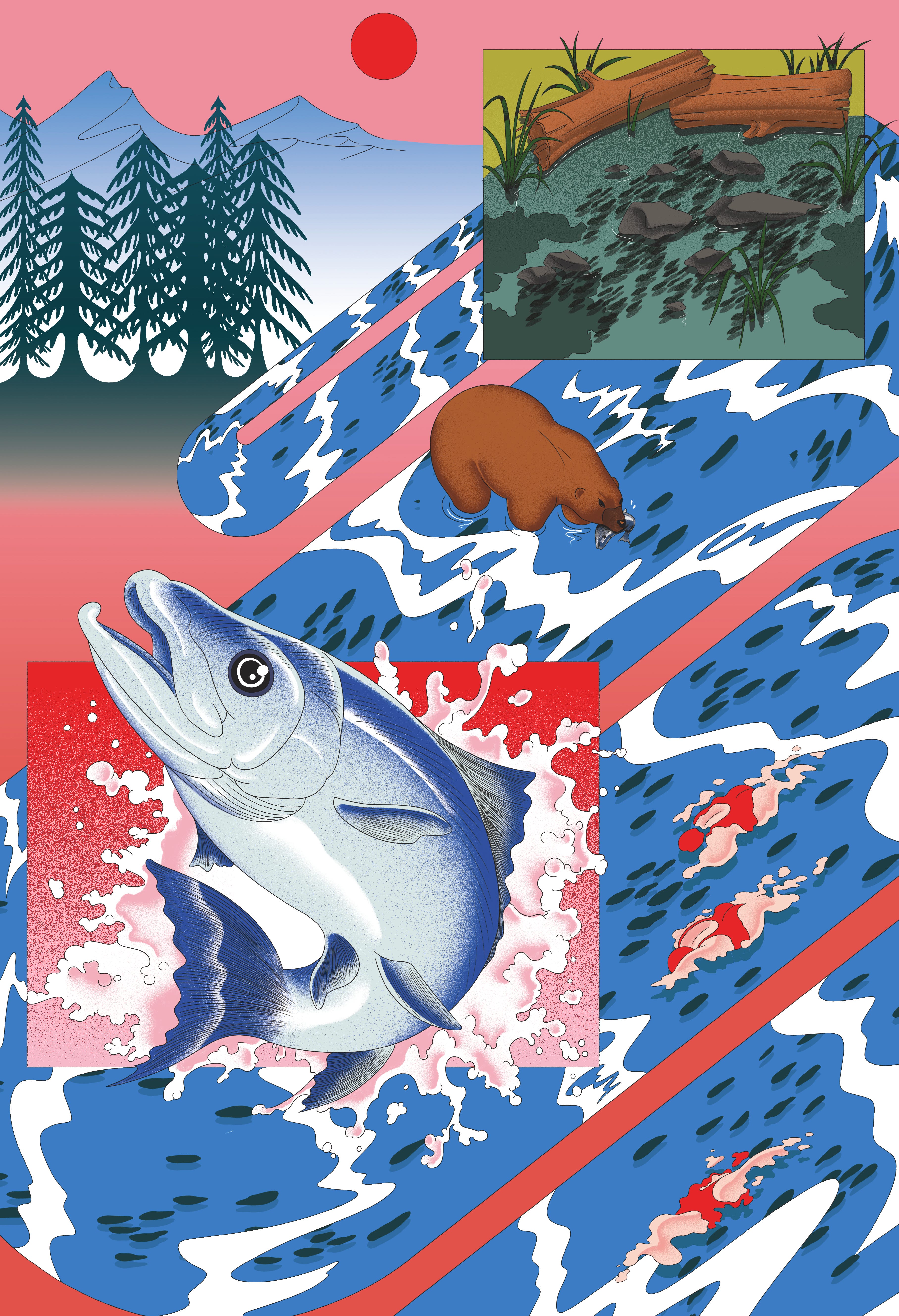
WORDS BY JAIME LOWE
ART BY INJI SEO
VICTORYJOURNAL.COM
The river is crowded, claustrophobic, wall-to-wall with rotting flesh. In the beginning, the bodies are strong, moving fast against rapids and walls of water. By the end, those same bodies, exhausted from the effort, just barely keep course. The fetid smell is persistent, overwhelming, something out of nightmares. Death and slipping scales, gelid skin, the end of everything that was, salt, minerals, and protein dripping away with every attempt to work past the current; the salmon, the gang of salmon, the mass migration of salmon, keeps on pushing, swimming dead-eyes-first into waterfalls and whitewater currents, flopping through gravel, shimmying through shallow graves.
They are always moving toward the place once known, back beyond the breach of salt water to the freshwater tributaries of their protected youth. Not home, not at sea; not living, not dead; not schooled, not alone; not still. Just motion, just forward trajectory. The salmon—hooked jaws screaming, rainbow skin that will turn ashen with time—follow an instinctual pull. And for what? The one-in-a-million chance that their eggs are fertilized, kept safe, survive, and that their offspring eventually spawn another generation of wildness.
I. Children of the grave
The eggs are cream-colored with a hint of orange. They are lopsided and spherical, each pinpointed with a black dot—an eye watching, waiting to burst through. The eggs sit in a cool, calm freshwater stream, a tributary lined with bones and bleached decay, the remains of their mothers and fathers. The river is an offshoot of the Columbia that dead-ends near a dirt road. It’s lined with new scruff and fallen logs—twigs, wood, and leaves that provide shade and hiding places for a nest. Shadows lurking under shadows.
Next to the lifeless bodies of the previous generation, the baby salmon emerge, still attached to the yoke that they will eat for up to a month. They are translucent before growing into trembling iridescence. After spending their first month among cool corners and safe nooks, the baby salmon—called fry—venture farther from the nest, where they eat the soft bodies of the previous generation—what’s left of their ancestors.
As juveniles, they stall for a year where rivers meet an endless horizon of salty Pacific. Here they mutate, becoming salmon that can live at sea. In the estuary their gills and kidneys begin to change so that they can process salt water. They are anadromous, living in both fresh-water and salt water. They go through smoltification, physiological and morphological changes; they shift kin, donning the dark back, light belly, and silvery coloration that allows open water fish to blend in. They become fish that seek out deeper water and avoid light. They remain in brackish waters and tidal creeks until this transformation is complete and they enter the ocean.
II. Into the void
Pacific salmon—sockeye, coho, chinook, chum and pink—are fleshy, hot red, and spotted like cheetahs, sometimes fierce with menacing underbites. Salmon live at sea, thousands of miles offshore, for three years or so. They are sometimes alone and sometimes together, schooling to fool their predator, lining up to flash big silvery skin that tricks whales, dolphins, and galloping orcas into not swallowing them whole. If salmon had only natural predators, their continuing life cycle would still be phenomenal. A single female salmon can carry thousands of eggs, but very few of those eggs survive to maturity. Female salmon can lay up to 10,000 eggs; then between zero and 10 live to be adult salmon and spawn again.
After years at sea, sucking down herring, pelagic amphipods, and krill, salmon are overcome by an instinctual pull to return to the freshwater rivers of their birth. They know, rooted in their bellies, to return. They are fat and ready. They have absorbed as many vitamins, as much strength, as much life as possible from the ocean; they return to the gravel beds of their youth to extend their species through future generations. No one knows why they return to that specific place. They spawn to die, they spawn to live.
III. Eyes of a stranger
They reorient and remember the cool, calm place they came from and make their way back, smelling the sensational path they left as juveniles, pulled back to the exact freshwater place they knew as youths. A salmon can detect one drop of water from its home stream in 250 gallons of seawater. They find the mouth of their particular tributary, the place that served as a bridge between adolescence and adulthood. Scientists believe salmon use a combination of magnetic orientation, celestial orientation, the memory of their home stream’s smell, and a circadian calendar to return to that natal stream.
When adult salmon reenter freshwater, their bodies transmogrify. An adult female’s belly grows; an adult male may develop a hooked snout, humped back, and elongated teeth, all used to attract a mate and defend spawning territory. All salmon stop feeding when they reenter freshwater; their stomachs disintegrate to make more room for sperm and eggs. They starve themselves like a wrestler making weight, surviving entirely on the nutrients they’ve stored from their years at sea. White Salmon River, two hours east of Portland, Oregon, is named after the salmon that arrive pale from vitamin depletion. Their flesh begins to rot, chunks falling off along the way.
IV. Caught in a mosh
A throng of hook-nosed red bodies crowd together, pushing above water, forward, thrashing, leaping through the air, throttling themselves up, climbing waterfalls—a natural anomaly. They migrate hard against the current. Topping the waters from below, fish bodies push violently through the surface, moving forward against the velocity of a downstream pull.
But the rush of bodies barely happens anymore. Humans have made spawning scarce and unpredictable. After decades of species decimation in the dammed Northwest river system, salmon and other native freshwater fish will face extinction within the next century. Their migration can extend 900 miles inland and 6,000 miles in elevation, all the way into the mountains of Idaho, carrying essential nutrients—phosphorous, nitrogen, calcium—everywhere they go and everywhere they die. They are a staple source of protein and vitamins for other species on the brink of extinction, like grizzly bears and orcas. The 79 remaining Southern Resident killer whales in the Salish Sea are listed as endangered under the federal Endangered Species Act. A limited food supply has been identified as one of the primary reasons for their decline—chinook salmon make up more than 80 percent of orcas’ preferred diet. If salmon die off, others will follow in their wake.
V. Slaves beyond death
Male salmon arrive in spawning grounds first to stake out territory. Some swim 200 yards, others 2,000 miles. They snap at each other, biting and braying, and show off their elongated snouts. A female salmon who makes it all the way upstream to the place of her birth will dig several depressions, a network of nests called a redd. She flips her tail, fast and hard, kicking up gravel and dust. She may lay between 2,000 to 5,000 eggs before she is spawned out. A male fish will then fertilize those eggs, sometimes battling for the privilege. Sometimes the eggs will be fertilized by more than one male fish. A haze of white smoke like a fog machine coats the pile of tiny orange spheres. The adult salmon stand watch over the eggs, dying, rotting, decomposing, over their hypothetical future—death that provided life and continues to.
Subscribe now and receive a couple Victory stories a month, straight to your inbox. We’d love your paid subscription support if you’re able. It helps us keep doing what we’re doing. In the meantime, look out for more great digital content, and we’ve still got copies of back issues, as well as subscriptions available. There’s never been a better time to enter into the world of Victory Journal. There’s a lot to discover.