LeRoy Neiman: Through Line
One of 20th century America's best-known painters was also an incredible sketch artist and sports journalist.
WORDS BY BUD SCHMELING
IMAGES COURTESY OF THE LEROY NEIMAN FOUNDATION
There is a group photo taken in 1985 at a New York restaurant called Mr. Chow’s, a shot arranged by Eric Goode, then the owner of the legendary downtown club, Area. It features pretty much every NYC art-scene heavy hitter working at the time: Keith Haring, Andy Warhol, Jean-Michel Basquiat, Robert Mapplethorpe, Julian Schnabel, Francesco Clemente. And there in the back row, raising a champagne glass, is LeRoy Neiman. According to the musician John Lurie (also featured in the photo), Neiman “had no idea what he was doing there.” The mustachioed bon vivant was almost as famous as Warhol, but had none of the art-world credibility. Yet there he was, among the downtown weirdos of the ’80s avant-garde. LeRoy Neiman was everywhere.
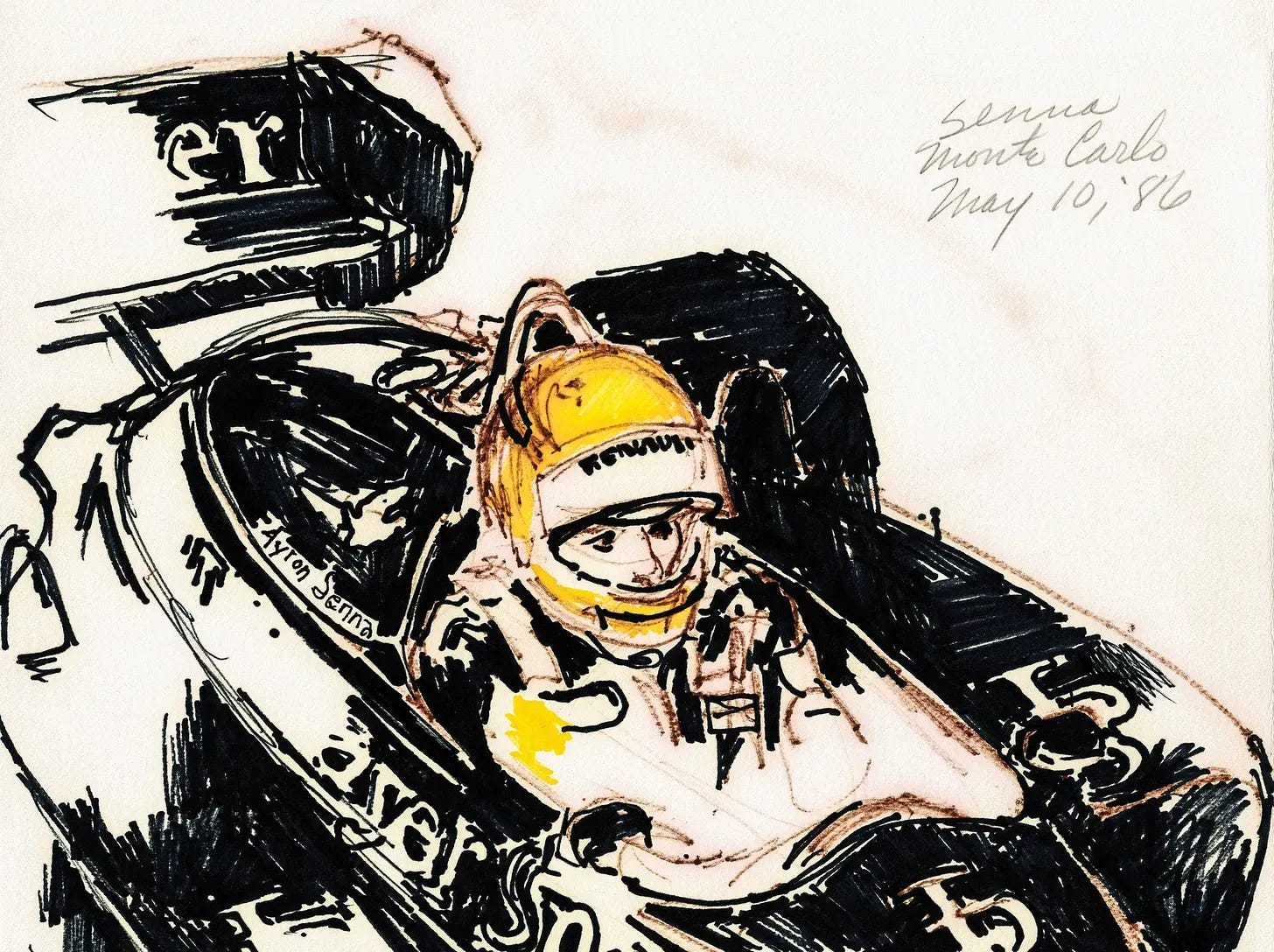
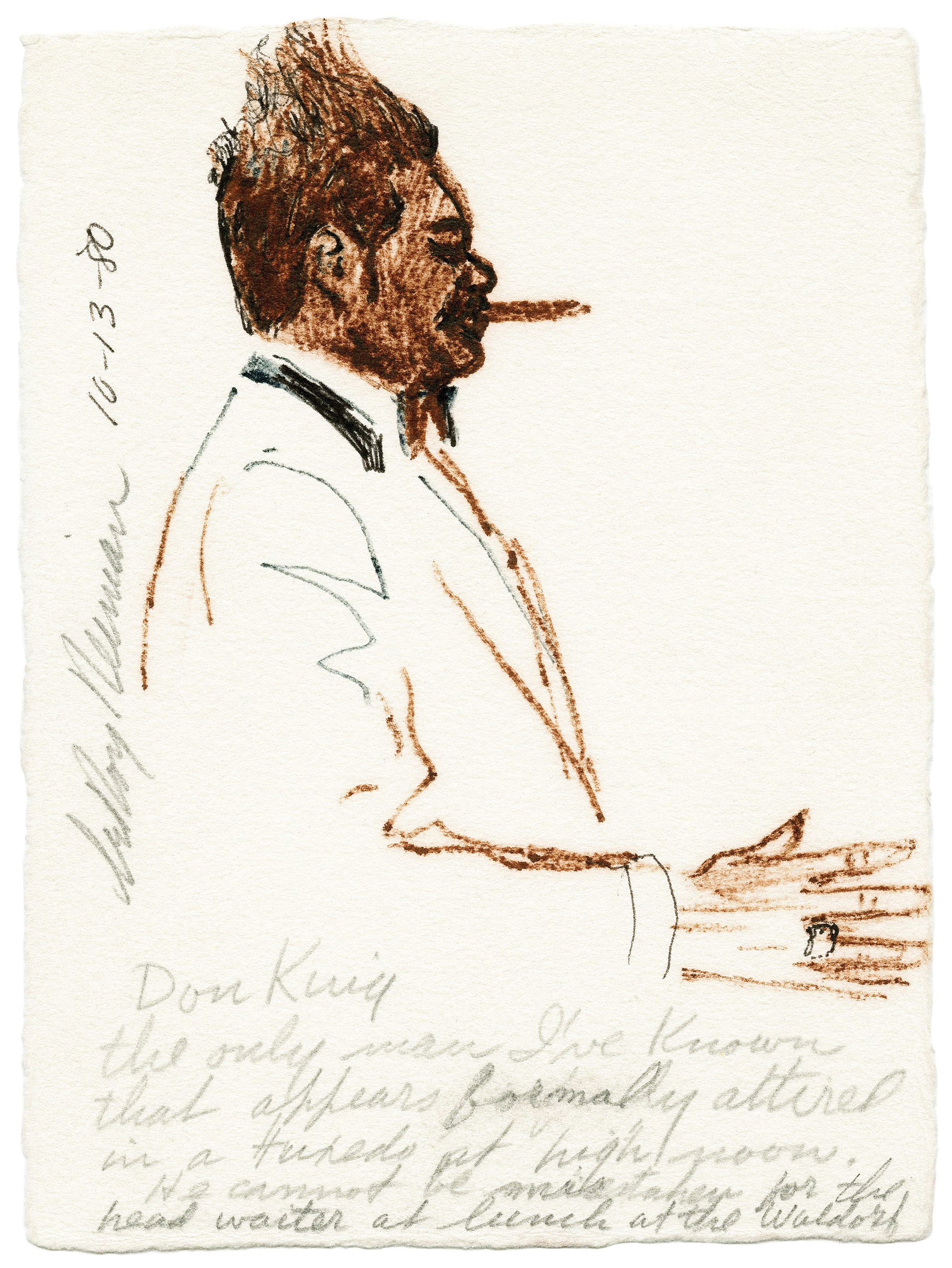
Mainstream America knows Neiman for his splashy and colorful oil paintings of famous athletes, all captured in his loose, kinetic style. He contributed to general-interest publications like Time and Playboy, as well as commercial outlets like Burger King and Wheaties. The world’s first, and maybe last, official sports illustrator, Neiman was present at virtually every major sporting event during the latter part of the 20th century, feverishly sketching away at Super Bowls, Kentucky Derbys, Olympics, World Cups, World Series, Grand Prix races, Wimbledons, and countless other championship games and title bouts. (It’s hard to imagine today, but Neiman was shown on live TV, painting watercolors during the Olympic Games throughout the ’70s and ’80s.) His work appeared on tickets, programs, commemorative posters, and adorns the walls of the baseball, football, and boxing halls of fame. As Don King memorably said, “LeRoy could do more with a paintbrush than a monkey could do with a peanut.”
Could critics and rivals have been jealous of his financial and commercial success? Were the affectations of the cloak-wearing, stogie-smoking dandy too indigestible? Or maybe it was that the rich and famous people who Neiman was drawn to as subjects were never explored as anything beyond rich and famous. Whatever might have motivated the opprobrium, Neiman was never bothered by the fine-art world’s cold shoulder. “Early on I’d found myself on the wrong side of the art scene, but, being born on the wrong side of tracks, that was just fine with me,” he wrote in his 2012 memoir, All Told. “...I’d rather be a folk hero to 40 million Playboy readers, any day, than an icon among the airless art elite.”
From a very early age, Neiman (born Runquist, adopting the surname of his stepfather after his dad abandoned the family when LeRoy was a small boy) recognized and cultivated his talent, intoxicated with the effect it had on people and the opportunities it brought him. After serving in WWII, Neiman received his education through the GI Bill, attending, and then teaching at, the prestigious Art Institute of Chicago. Around that time he began to develop his signature style—he happened upon a bounty of discarded house paint, and discovered that through rapid application, the overflowing paint "simulates movement." He soon had the ridiculously good fortune to meet an ambitious copywriter—by the name of Hugh Hefner—who was about to launch one of the most culturally influential publications of the century. And when in 1954, Hefner decided that Playboy's jokes page needed some visual assistance, Neiman came up with the Femlin, an ink sketching of a seductive siren in thigh-high stockings who would appear in every issue for the next 50 years. A few years later came the recurring column "Man at His Leisure," with Neiman playing the part of globetrotting gadfly, sending back illustrated dispatches from the nude beaches, casinos, and discotheques of swinging-’60s Europe. In All Told, Neiman reflected, "My whole career has basically been built on taking man-at-his-leisure seriously!"


Bouncing around the world on Hef's dime is how Neiman transformed into a Zelig-like character, and his impressive Rolodex wasn’t even limited to the best and the brightest of the sporting world. Because of his George Plimpton–esque presence at the crossroads of sports, politics, arts, and popular culture, over the years Neiman sketched portraits of such disparate figures as Joe Namath, Roman Polanski, and Fidel Castro, while befriending icons like Sinatra, JFK, and Ali. But it was in 1960, when he covered the Winter Olympics in Squaw Valley, California, that sports became his true calling. Amidst the high-profile, televised assignments, there he was as the team artist for the New York Jets, always situated on the sidelines, his pen moving furiously. (Neiman was so popular that during one particularly frustrating game in 1975, the fans at Shea Stadium began chanting, "Put LeRoy in!") His never-less-than heroic depictions helped transform athletes into celebrities. "To point out how the strong man stumbled, or how an athlete might have succeeded, but didn't, is outside my appetite," he wrote in his monograph, Winners: My Thirty Years in Sports.
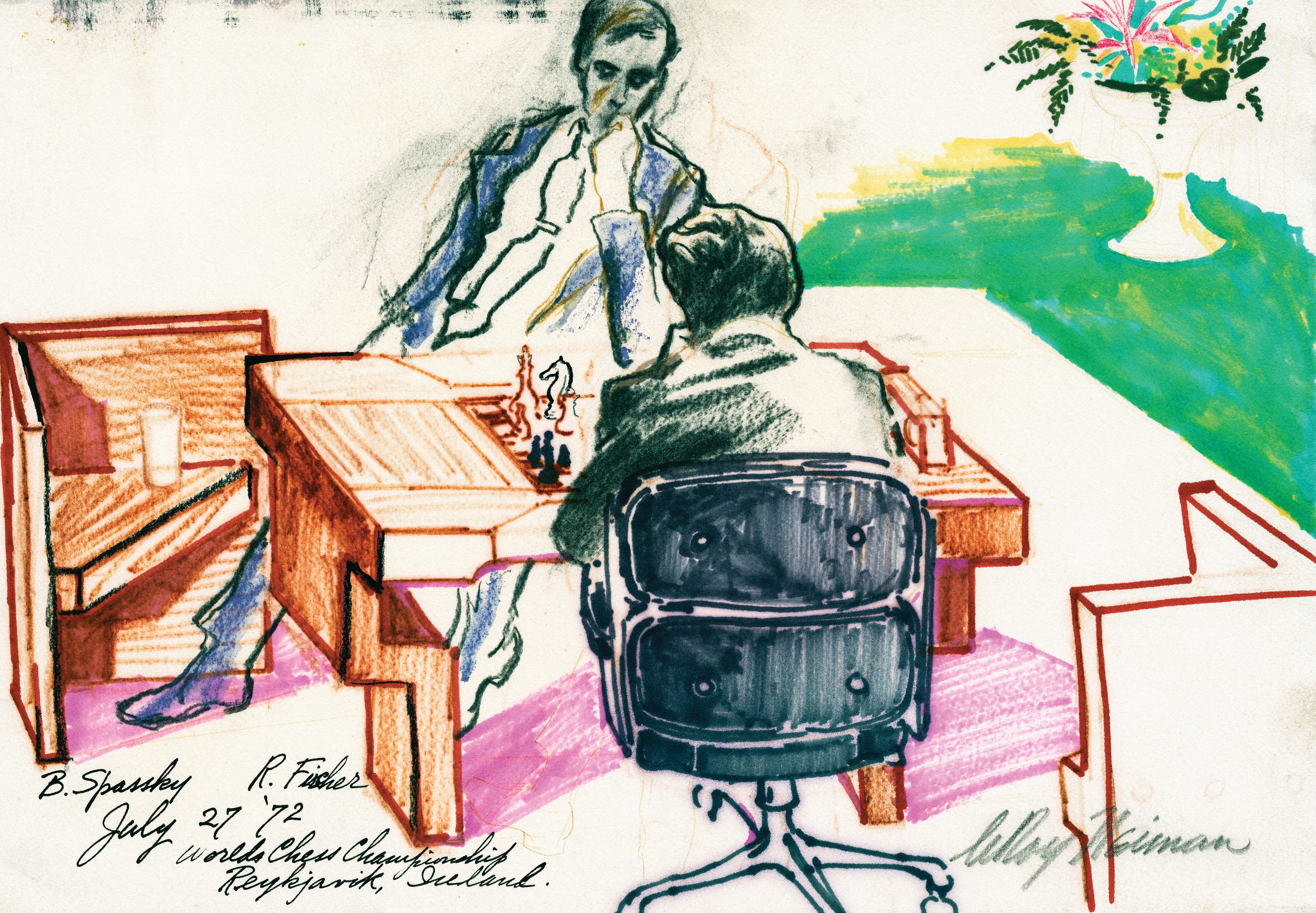
Neiman managed to capture split-seconds in sports with an impressionistic yet informed perspective. In his sketches from the field he utilized a solid line and a reserved tonal palette; unlike television or photography, these drawings freeze a fleeting moment of action in a free-floating space without ascribing an overt meaning. Neiman found the stillness in both massive and mundane athletic movements, insightfully casting a single rapid motion as an instant bit of magic. Just note the study of ‘Pistol’ Pete Maravich from his LSU days, where within one page Neiman’s quick doodles of dribbles and free throws lead to the more fully formed, filled-in images of Maravich pulling up his gym socks (one of the player’s signature tics). Or consider Neiman’s depiction of Boris Spassky and Bobby Fischer’s 1972 World Chess Championship showdown in Reykjavik (the artist was allowed to remain in the room long after Fischer had kicked all the cameramen out). The drawing’s construction is spare and geometric, except for the two gray figures locked in their contemplative standoff. It’s a Cold War moment if ever there was one.
Neiman’s work was never overtly political by any means, but he was there, visually recording an era of extraordinary change. A confidant of Ali’s, he followed the Champ’s career from the earliest Cassius Clay days to his final punches. Neiman, an unabashed fan of the sport, was granted inside access to the most intimate pre- and post-fight moments. In one of his most affecting sketches, from 1964, Ali is shown deep in conversation with Malcolm X and a Black Muslim advisor, the scene rendered with Neiman’s quick skill, fluidity, and unflinching devotion.
"Something was ready to explode—I could feel it," Neiman recalls of that meeting, yet another instance of his being at the right place at the right time, always ready to pick up the pen and sketch on whatever canvas was available. Like Ali, his staying power was off the charts. "Ali’s greatest achievement, in my mind, wasn't that he won the crown three times," Neiman said, in a statement that could apply just as equally to himself, "but that he did the same act for 20 years and never bored us."
Subscribe now and receive a couple Victory stories a month, straight to your inbox. We’d love your paid subscription support if you’re able. It helps us keep doing what we’re doing. In the meantime, look out for great digital content, and we’ve still got copies of back issues, as well as subscriptions available. There’s never been a better time to enter into the world of Victory Journal. There’s a lot to discover.