Cold Blood
Python hunting and snake wrangling in the Everglades.
WORDS BY AMOS BARSHAD
PHOTOGRAPHY BY BALARAMA HELLER
VICTORYJOURNAL.COM
Joseph Wasilewksi lives in a compound in Homestead, Florida, with albino iguanas, tegu lizards, red-footed tortoises, Gila monsters, a crocodile named Wally, and an alligator named RJ. The front of his house is lined with cattle skulls and massive palm fronds in pots and a chain-link fence reading “Caution: This area patrolled by sentry dogs.” He is tall and broad, with orange hair and orange stubble, and looks just perfect in his camo pants and hiking boots. Officially, he’s a conservation biologist. Unofficially, he’s a South Florida legend. JoeWa.
For decades, working alongside universities and preservation unions, Wasilewski has done conservation work locally and internationally. In the mountainous Western Ghats region of India, he’s radio tracked 18-foot king cobras—“The only animal that can kill an elephant besides a man with a gun.” In the Congo he did forest protection work for nearly a decade. “They got guerillas,” he says, “and I mean the ones with them mini-14s.” And when he’s not trotting around trying to save things, he’s putting on a show. The Zoo Miami expo is coming up, and Wasilewski will be overseeing their reptile exhibition. He takes me out back to show me some of the little pals he might display.
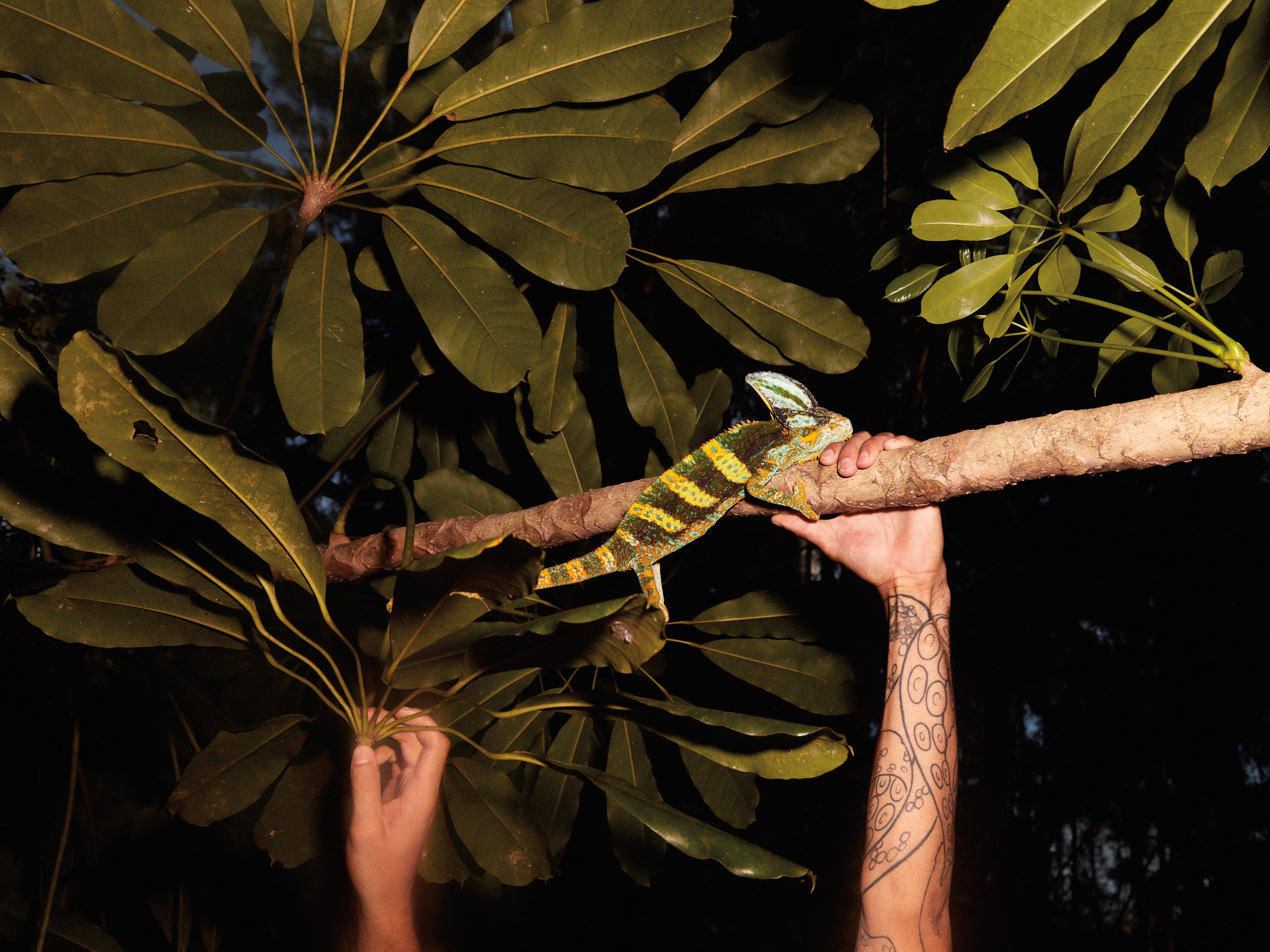
We walk under Spanish moss by a massive, snarling T-Rex mannequin, and past cages of bright green iguanas hanging perfectly still. Chickens run around our feet; Wasilewski seems mildly surprised to see them. We get to a massive Galapagos tortoise and Wasilewski happily plucks some green leaves to feed her. She is a lumbering, adorable beast, and her name is Buckshot. “She was the size of a quarter when I got her!” he says to me. Then: “Wow, your face is a mess!” That’s addressed to Buckshot.
We make a pit stop in a trailer full of venomous snakes, sidewinders and rattlesnakes that Wasilewski himself plucked out of mountain ranges in southern Arizona. He spoons one out with a metal rod. It has an elegant black-and-white pattern and the still air of unspoken menace. Seeing me wince, he says, “Oh, you don’t have nothing to worry about.”
“They wouldn’t attack?”
“Hmm? Oh, he’d bite me right now.” It turns out, in fact, that Wasilewski had taken a bad bite just a few years back. It took 48 vials of antivenin to revive him. The necessary antidotes were sourced by his son from snake doctors all over the country. Wasilewski was in the ICU for nine mostly unconscious days.
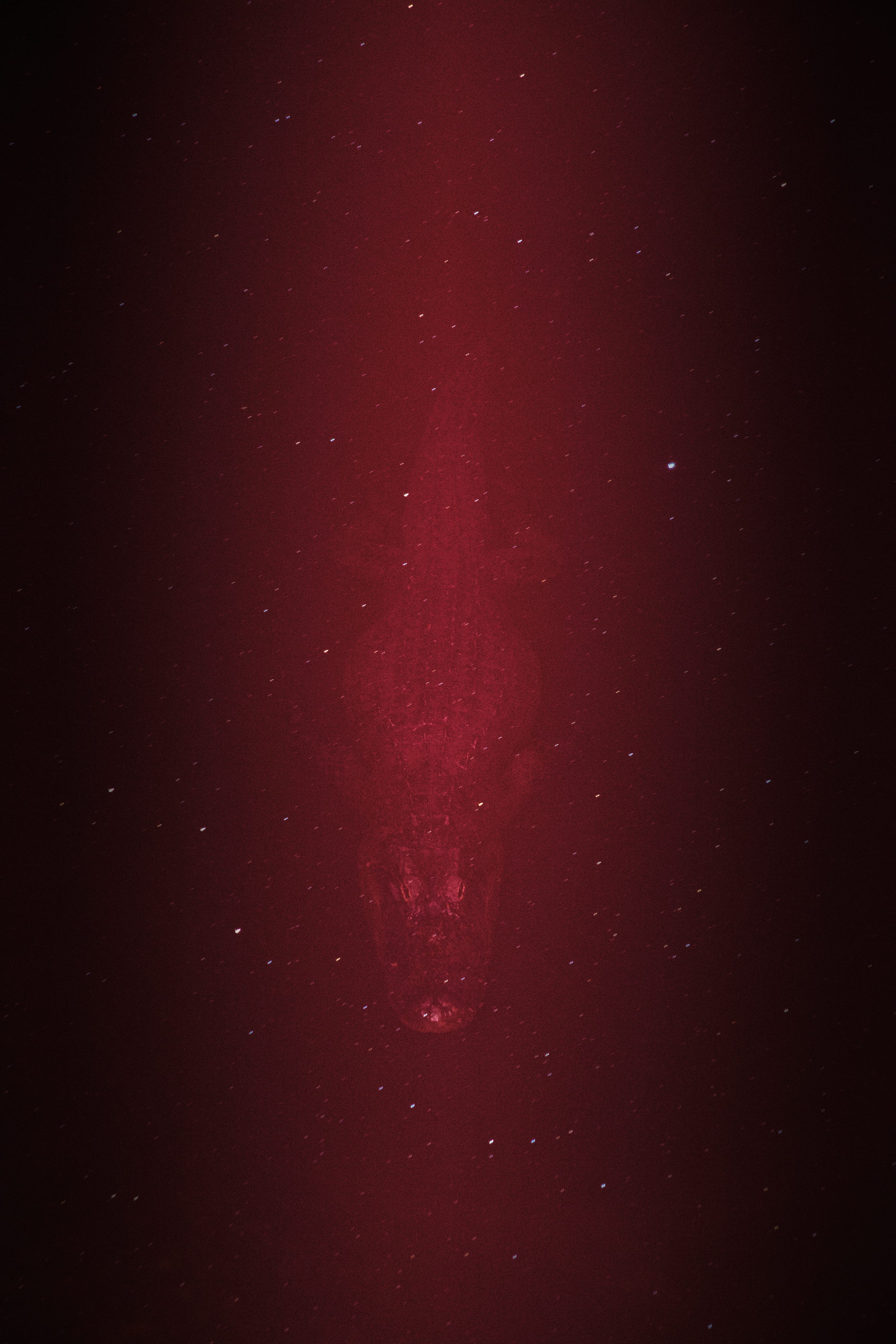
When he tromps on into a low stone enclosure, I follow behind. Then I see RJ the alligator, and I stop. RJ is hissing, teeth bared. She’s nesting, Wasilewski explains, jabbing toward a mound of leaves and dirt with a wooden pole. She’s done it annually—despite the absence of a mate, and therefore the absence of eggs—ever since he pulled her out of the wild.
Usually she’s more friendly, Wasilewski assures me. He even had her do a commercial for an outdoor furniture company once; she sat on a lounge chair and everything! Now her maternal instincts have her protecting future hatchlings that don’t actually exist. Wasilewski shrugs.
“She’s pissed.”
As a kid on Chicago’s south side, Wasilewski’s only access to reptiles were a few spare library books. He’d read them over and over again. Now he has a goddamn alligator in his backyard. His mother was a housewife. His father was a policeman. “My dad just passed away, ninety-two. He was still waiting for me to get a job. He still thought I just played with snakes.”
II.
I’d gone to Florida intending to spend a few days in Broward County and the Everglades wetlands with a young man named Nick Bishop, aka Nick the Wrangler. Nick has an active YouTube feed, a stated desire for fame, 33,000 Instagram followers, and a knack for finding snapping turtles and redheaded agamas and Eastern diamondback rattlesnakes. Photographer Balarama Heller has been shooting Nick and his cohorts in their nocturnal pursuits for years. Days before I arrived, Nick let us know he was dealing with personal issues that made an interview impossible. But I didn’t have to look far to find other critter-obsessed people to take me to the swamps.
South Florida is the domain of a remarkably varied and passionate band of animal lovers. “Some are biologists or ecologists or herpetologists—“herpers”—specialists in study of reptiles.” Some are amateur reptile maniacs who’ve just figured out how to crack a living in the biz.
I stay at the Galt Villa Inns, a drive-in motel that’d be beachside if it wasn’t stuck on the wrong side of a two-lane thruway. One morning, chugging through free refills of hot coffee in the sun at the bar of the motel pool, I fall into a chat with the bartenders, Willie and Jill. They’re both blond, smiley women in their 50s wearing hotel-uniform teal polos with the certain but distinct energies of Florida lifers. Willie’s tall and cocky and has plastic purple sunglasses and long fingers full of gem-stones. Jill, smaller and peppier, has her hair in braids. Save for a turtle necklace, she is unadorned.
I tell them I’m headed for the Everglades, and they shout at me, “Zigzag!!”
Pardon?
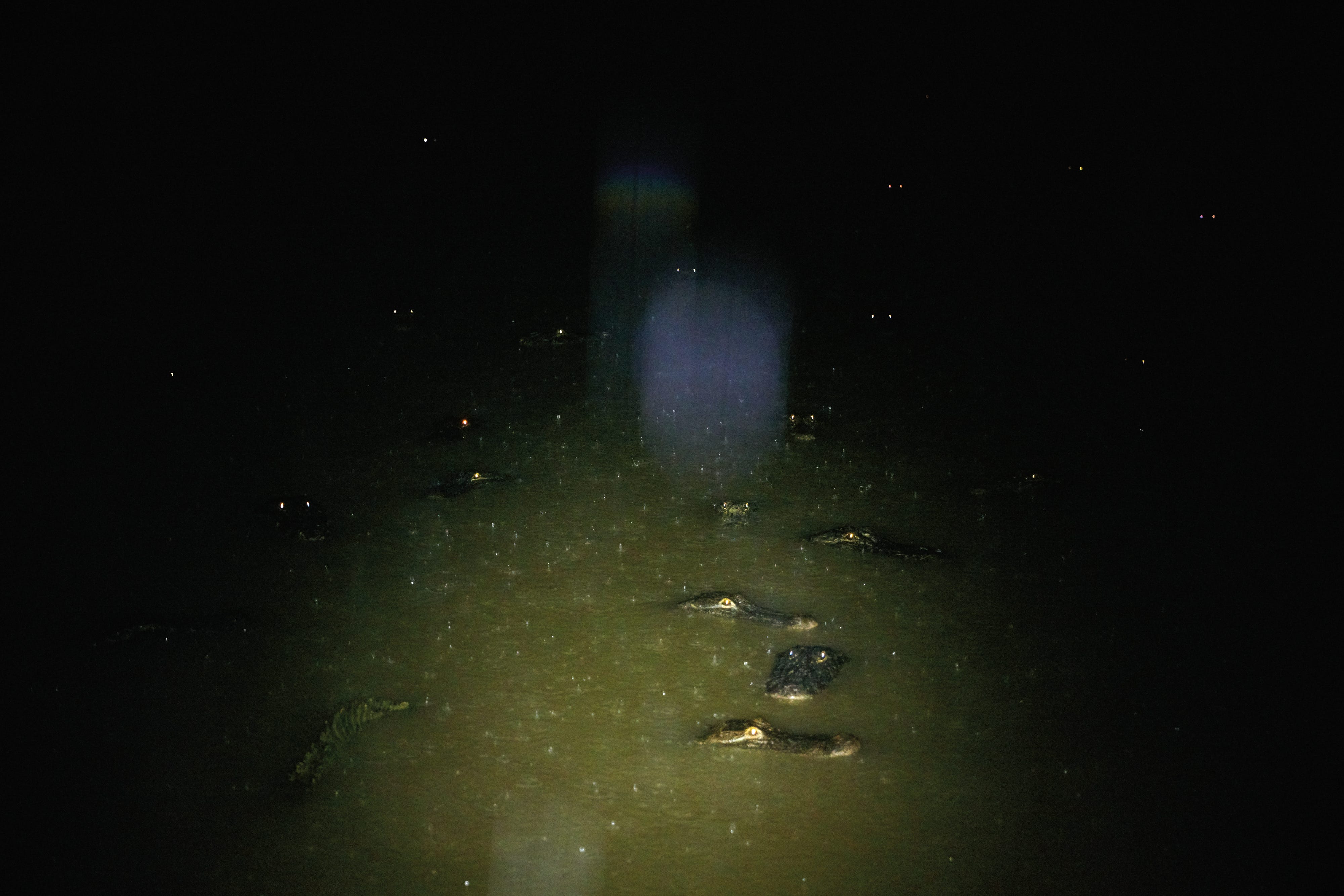
“They can get you with their tail,” Willie says. She means the gators. “You gotta haul ass!” She moves her arm from left to right, exhibiting the exact method in which I have to haul ass. “Zigzag!”
“You know about the death roll?” Jill asks. I do not know about the death roll.
“They don’t like fresh meat,” Willie says, “so they’ll roll you and roll you and roll you and then drown you and then…” She walks away to tend to a customer before providing any more details, but I get it, I think.
III.
“You’re out here and you jump on a big snake,” Tom Rahill tells me as we cruise through the Everglades in a rusty Ford pickup packed full of pillows and Wrangler shirts still on yellow plastic hangers. We’re looking for pythons. “And it works, dude. It’s unreal how well this works!”
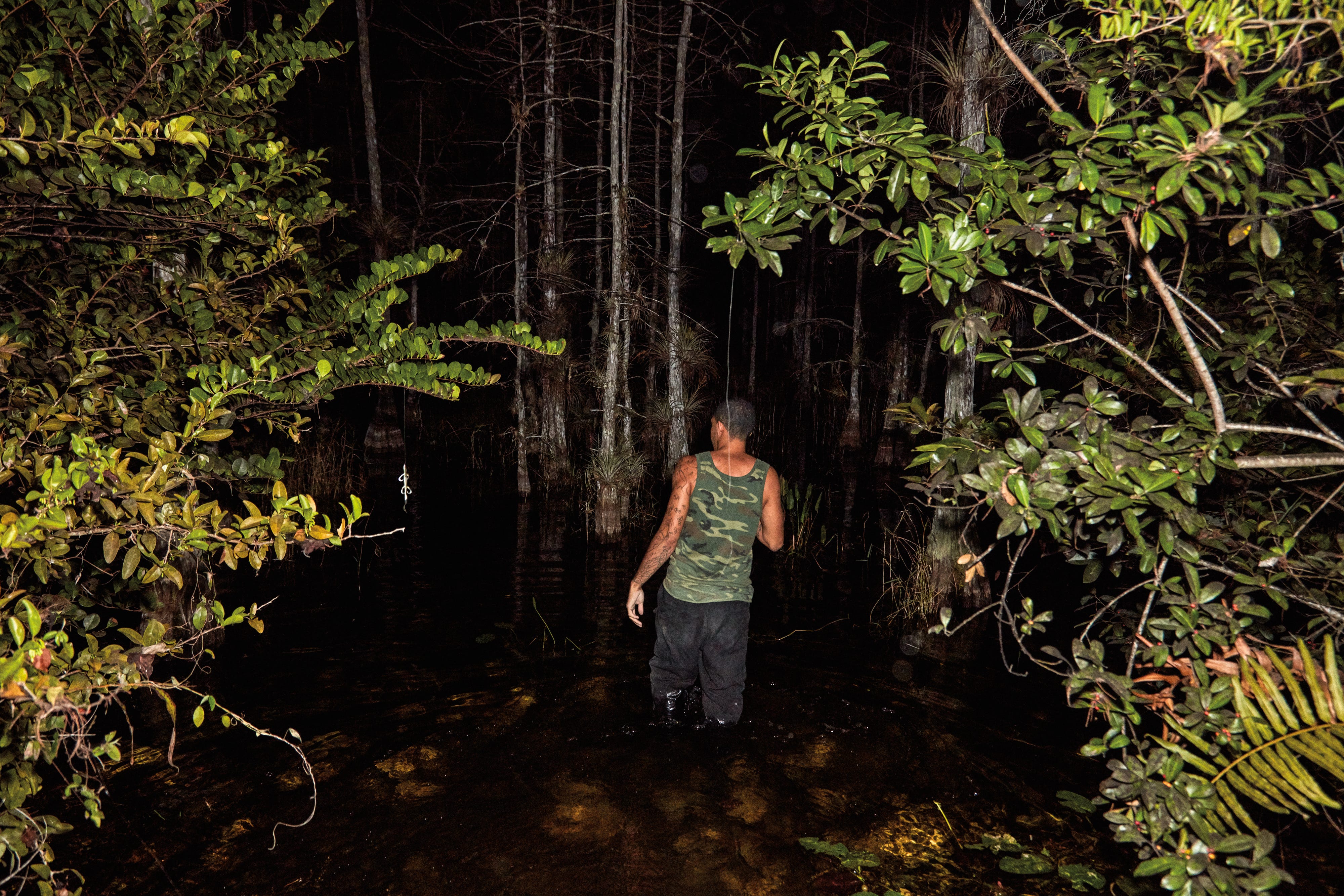
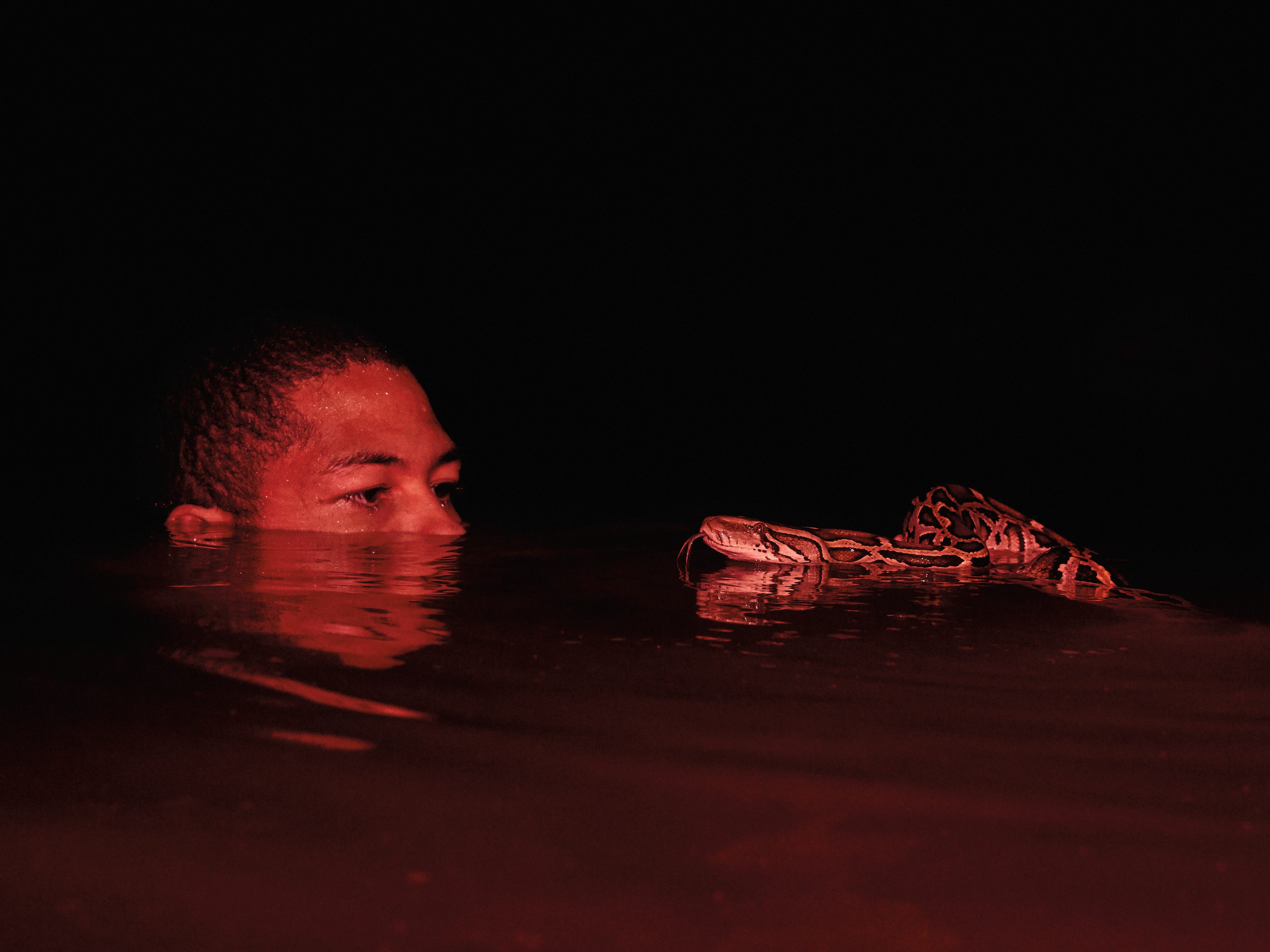
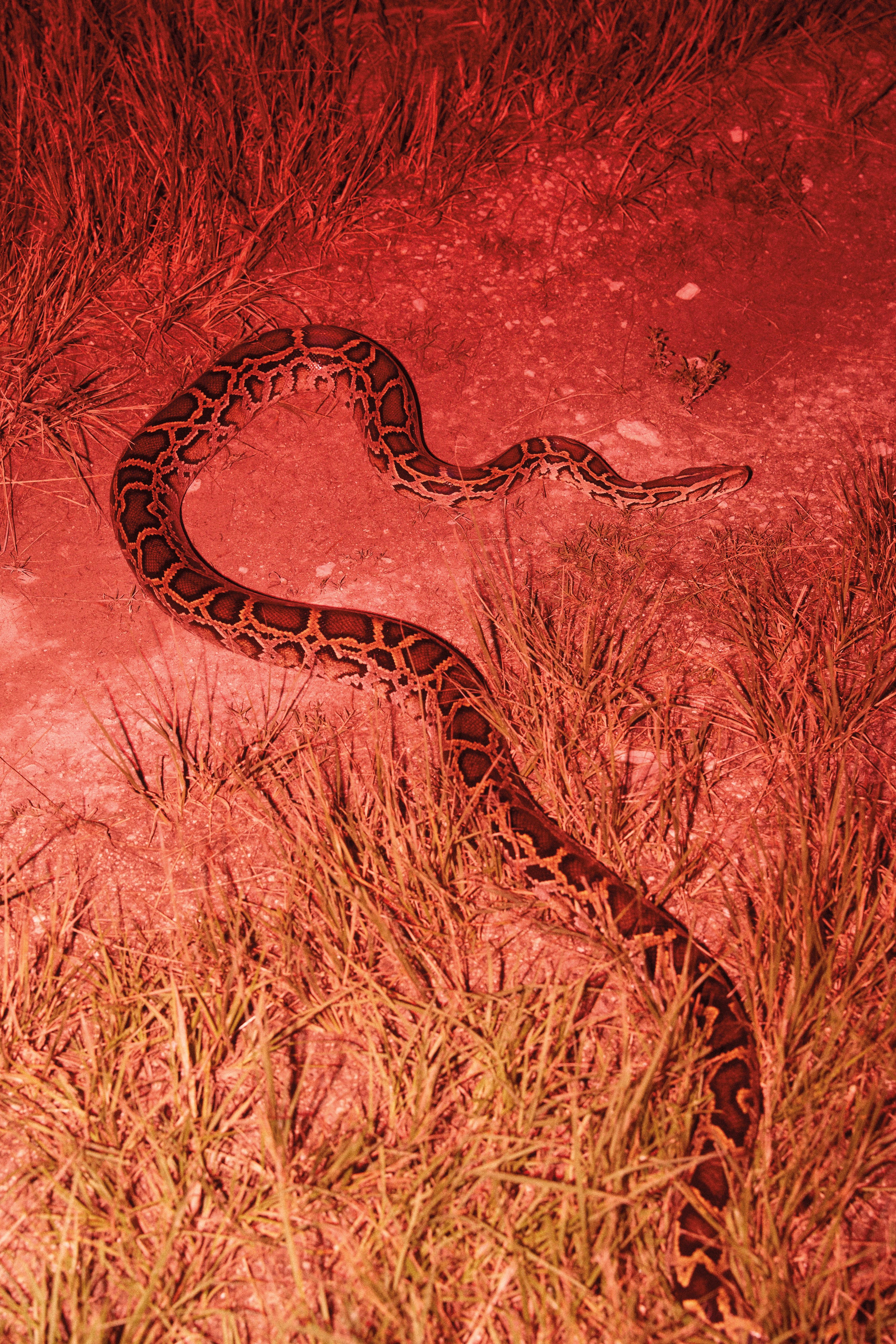
Pythons are an invasive species that have chomped down on the Everglades’ natural bobcat, raccoon, and rabbit populations. So the state of Florida licenses contractors to kill them. Rahill’s the only contractor who’s turned his pythoning into charity: His organization, Swamp Apes, brings US armed forces veterans out for catharsis through snake-killing.
Now it’s midnight. We’ve been driving around the levees for hours, and even though we haven’t jumped on any big snakes I’m starting to see the therapeutic appeal. We’ve talked about everything: his wife’s medical problems; his children’s ambitions; his abusive, alcoholic father. “The only happy moments I had when I was a kid was when I was out in the woods,” he tells me.
At 17, his dad kicked him out of their upstate New York home. He landed with relatives in Jacksonville and fell in love with the Everglades. He repeatedly calls them “rugged,” which I come to understand is the highest form of praise in Rahill’s lexicon. He’s been out here in 120 heat index in thick snake-repellent clothes with swarms of mosquitoes big enough to leave a shadow. He’s trudged through the pits of the swamps, happy for every gnarly step.
On the flatbed behind us is a vet named Hunter, a quiet young man in baggy blue jeans and a finely rendered scorpion neck tattoo. With the aid of two potent floodlights, Hunter keeps watch on the critters. I sit in the driver’s seat staring straight ahead, munching Wheat Thins while the road becomes a Lynchian dream-loop of saw-grass, reeds, and nighthawks drawn into our headlights. As we approach the birds flap away, one after another.
Hunter and Tom spot something and hop out of the car with quiet glee. A little basilisk on a reed: a Jesus lizard. A venomous cottonmouth. Then another, even bigger.
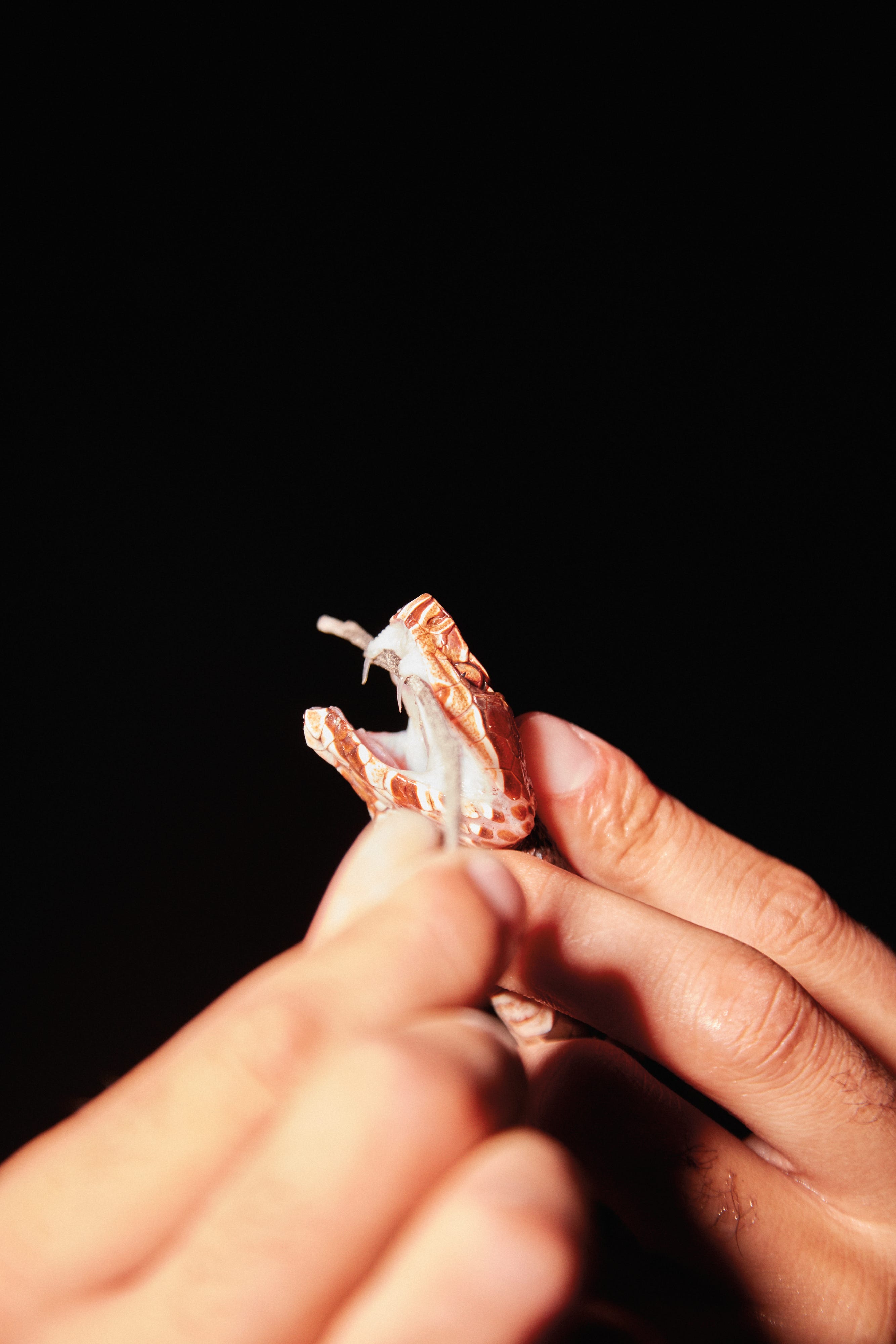
Tom: “That’ll kill you.”
Hunter: “Ruin your day, for sure.”
Then Hunter somehow spots an alligator head bobbing out of the water in the dark. We stop and the periscoping eyes stare us down. Next to the eyes is a massive nest of twigs, reeds, and mud. “That’s a momma right there!” Tom shouts, before belting us some Queen: “Moooommaa! Oooohoooooh!!”
Then, for a long while, nothing. We’re waiting for the air to drop, Rahill tells me. We’re waiting for a python to come up out of the darkness. It’s going to happen. I wonder if he has a touch of the obsessive about him. And I know there’s no way I’m going to be the one who suggests packing it in for the night.
By 2:00 a.m. I’m barely mustering the energy to talk, and we haven’t heard from Hunter for hours. But Tom’s a manic force. The sky is black and purple and Rahill’s bandanna-clad, bearded face is mostly obscured in the shadows. He croons a song he wrote about the beauty of North Carolina’s Transylvania County and another about the time he got smacked in the crank by a swinging tree limb while chainsawing. (I think at first crank means groin, but as the song continues I realize it means dick.) Then I hear about how, at the end of his life, before he passed, Tom’s father moved down to Florida. The two reconciled and even became best friends.
It’s late. We’re running out of time, still scanning, still praying for pythons. Finally, Tom says, we’ve got just one last run. “Stoppage time.” We see something—it’s a banded water snake. Tom pops out and picks it up, moving it out of the road. It pees all over him.
We never do get a python, and Tom’s endearingly apologetic about it. I want to tell him I feel like we accomplished something here nonetheless.
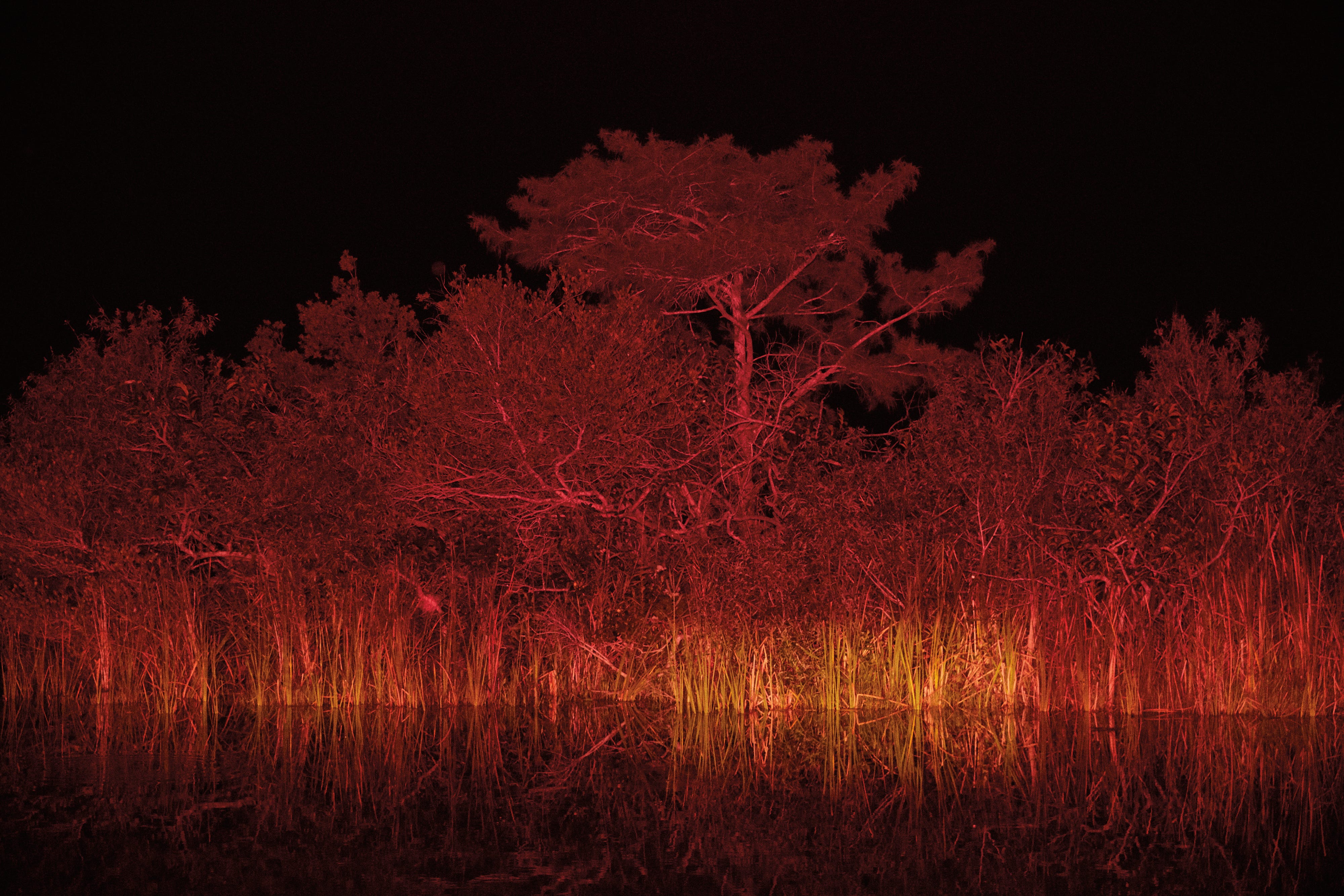
“What is my life worth! Nothing!” Tom says at one point, frogs squawking all around us. It’s a reflective mantra of his. A way to ease out of internal, churning anxiety. “The universe doesn’t care about me!” Grinning, I heartily agree that it doesn’t care about me either.
Subscribe now and receive a couple Victory stories a month, straight to your inbox. We’d love your paid subscription support if you’re able. It helps us keep doing what we’re doing. In the meantime, look out for more great digital content, and we’ve still got copies of back issues, as well as subscriptions available. There’s never been a better time to enter into the world of Victory Journal. There’s a lot to discover.