

3100
Each year, groups of runners congregate in Jamaica, Queens to run in the world's longest certified foot race. The catch? It all happens on a single city block.
Last year, photographer Thomas Wilson documented the annual Self-Transcendence race, which begins again later this month. For the first time ever, we’re publishing his account of the event that tests body and mind to its absolute limit.
WORDS AND PHOTOGRAPHY BY THOMAS WILSON
VICTORYJOURNAL.COM
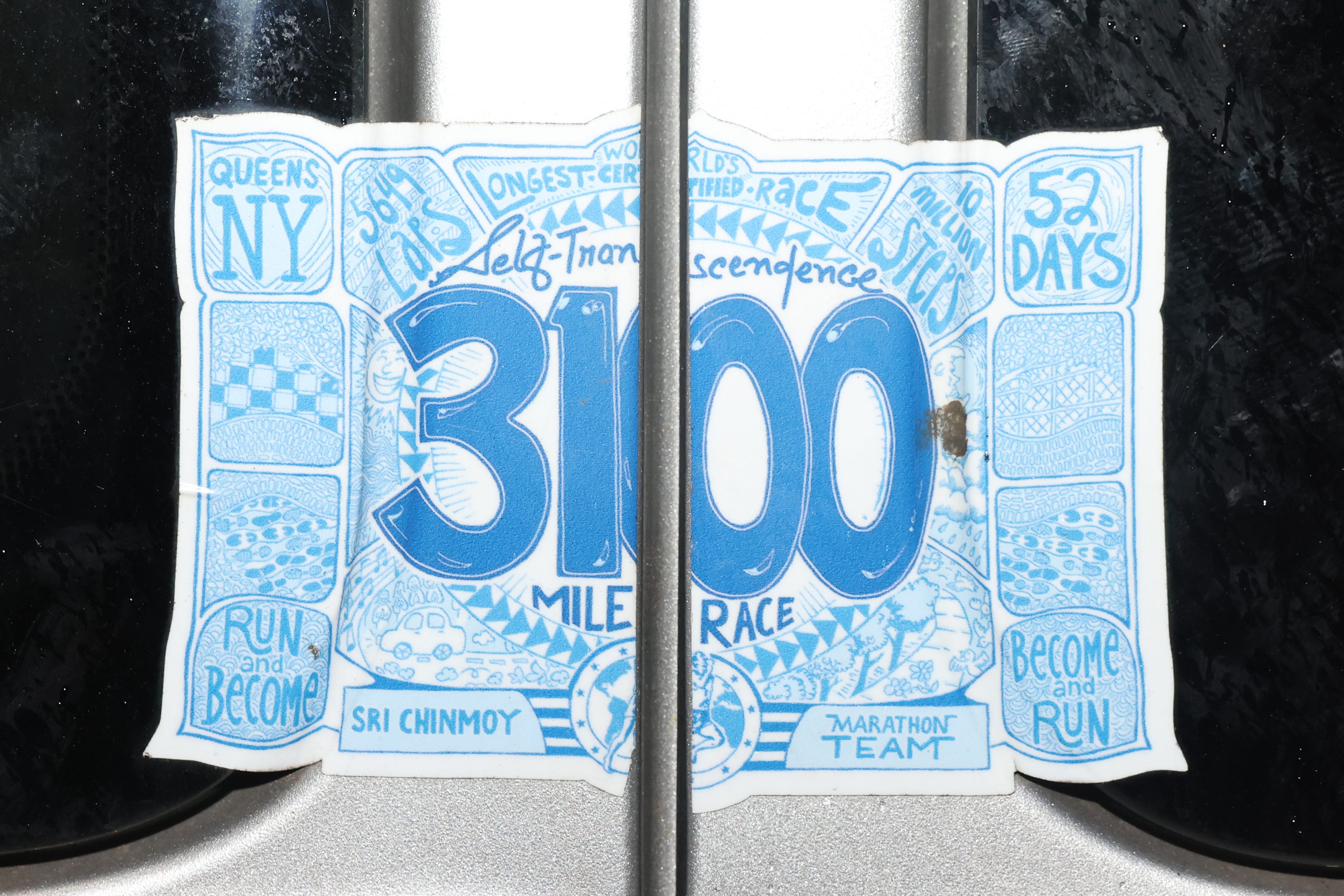
The longest certified foot race in the world is 3100 miles and takes place around a single square block in Jamaica, Queens.
The runners are disciples of a spiritual leader, the late Sri Chinmoy, whose teachings sometimes involve meditative endurance events. Chinmoy was born in 1931 in present day Bangladesh but moved to New York City in 1964. He amassed a following of 7,000 disciples through his spiritual teachings, music, artwork and physical feats, having been called the stuntman of spirituality. He is said to have created 22,000 songs, 140,000 paintings and over 1,600 books of poetry by the time he passed away in 2007. Chinmoy believed that peace could be manifested through various forms of self-expression, including sport and that self transcendence could be achieved through developing the physical, mental, emotional and spiritual aspects of life — which also involves taking a vow of celibacy.
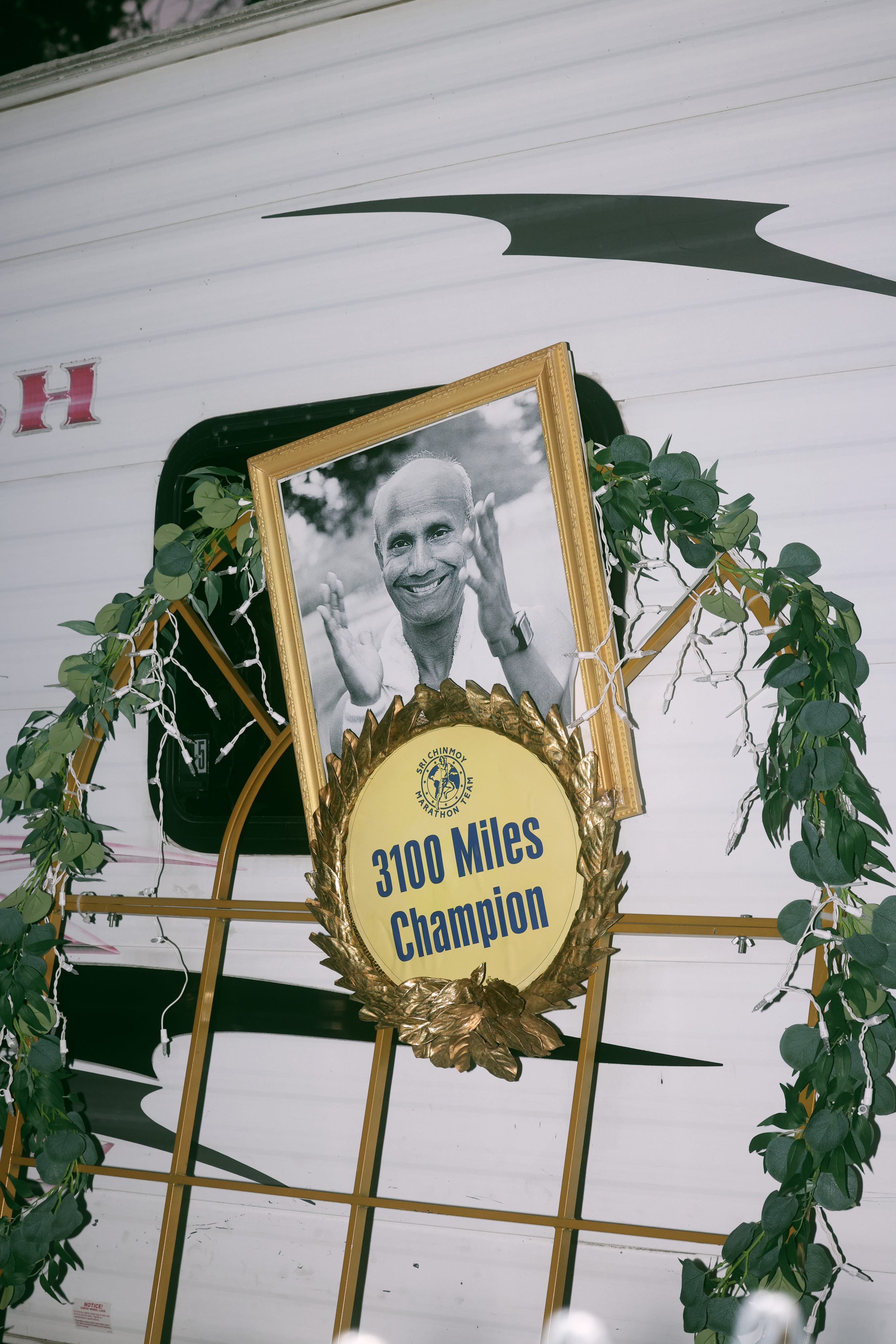
In the mid 1980s Chinmoy was spiritually motivated by his inner voice to lift weights in order to inspire humanity. He asked his disciples to invent a weightlifting apparatus that would allow him to lift dumbbells weighing several times his body weight over his head. In what was called the “Miracle Lift” he lifted a dumbbell weighing over 7,000 lbs above his head using only one arm. “What I wish to show by these feats of strength is that prayer and meditation can definitely increase one’s outer capacities,” he said in 1988 at one of his weightlifting demonstrations. He later transitioned to literally lifting up religious leaders, famous athletes and dignitaries by using a specially designed platform as a part of his program called Lifting Up the World With a Oneness-Heart. Notable individuals include Nelson Mandela, Muhammad Ali, Susan Sarandon, and Eddie Murphy. Chinmoy lived in a modest house in Jamaica, Queens and owned a purple Chevrolet GEO Tracker that he would drive to the race course to hand out prasad - a religious offering that is typically vegetarian food.


The Self-Transcendence Race is a stage race of sorts. The course is open from 6am until midnight and runners try to do as many laps as possible in the allotted amount of time, sleeping in nearby flats at night. Some runners stay with friends while others use vacation rental sites to find accommodations. Everyone stays within a mile of the race course so that traveling to the start each morning is as quick as possible. When it first began in 1996, the race was “only” 2700 miles long. The second year of the race, Chinmoy decided to lengthen it to 3100 miles, stating “In our philosophy, we believe in self-transcendence. So now we shall see who can do it.” (Supposedly, Chinmoy chose the new distance of 3,100 miles to reflect the year in which he was born.) The race, which is oriented around a Japanese red maple tree he planted at the entrance of Thomas Edison High on October 11th, 1975, takes a maximum of 52 days and less than 50 people have completed it since its inception in 1996.Training typically begins in the first two weeks of the 3100, not beforehand. Participants risk overtraining if they feel fully prepared on Day 1. After the two week break-in period, the runners' bodies adjust to the new pain threshold and lack of sleep. The sooner that happens, the better. It’s not uncommon for participants to lose all their toenails after running the entire distance, which is why most of them run in shoes with the tops removed to relieve pressure. There are a few gradual inclines that roughly measure 18 ft of elevation gain per lap. The inclines become magnified when runners complete upwards of 80 miles each day. Completing it is the equivalent of climbing Mount Everest 3.5 times.
On the opening day of the race, I woke up at 4am, got in my car and made the 15 minute drive to Queens along Grand Central Parkway, parking at 164th Place; one of four short stretches that make up the entirety of the .5488 mile course. At the starting line, a small gathering milled around, lit by nearby support trailers, which were illuminating the concrete course that the runners would spend the next seven-and-a-half weeks circling.
Runners need to average 59.6 miles each day in order to finish the 3100 miles in the 52 day cut off period; a period of time that Sri Chinmoy decided would be on par with the world’s best multi day runners. Everyone eats and drinks while they're running because there’s almost no time for stopping. Small wooden TV dinner stands are strategically placed in front of the team trailers as well as slices of fruit, oatmeal, soup, curry, crackers, and a variety of drinks. Sometimes flowers or blue pieces of paper with quotes from Sri Chinmoy decorate the table tops. Meals are also provided by members of the Sri Chinmoy Marathon Team who make an array of vegetarian dishes similar to what you would find at one of the organization's local restaurants.
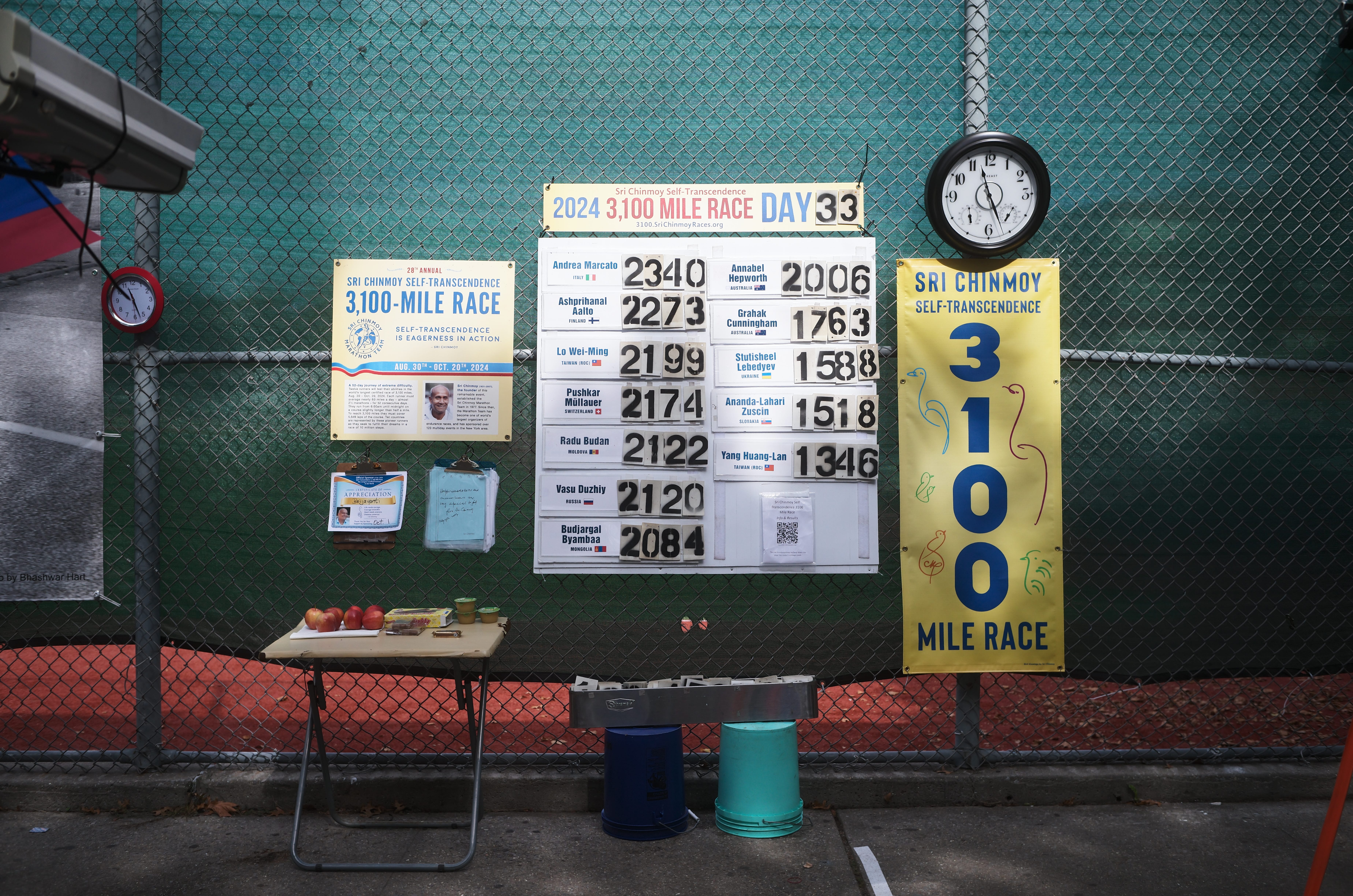
It’s easy to lose track of each runner when the race course is on a public sidewalk around a busy public school. Miles and laps for each athlete are recorded on ipads & clipboards by a rotating crew of disciples at a counting station. Counting the runner's laps is a meditation of its own. On a fence adjacent to the lap counting table is a giant scoreboard with each of the participants' names. That too, is updated manually. I gravitated towards the scoreboard area after being handed a spectator pamphlet that stated photos and cheering are encouraged within that part of the course, but due to the meditative nature of the event, not elsewhere.
I was standing in the designated spectator zone when one of the support members, a man named Arpan DeAngelo, was preparing small cups of food for the runner he was supporting. I asked him if he could show me around the outside of the trailer he was stationed at. He gave me a short tour and then began telling me about his running accomplishments. DeAngelo has completed the race three times and set the world record for being the first person over 50 to complete the distance. He was handing out cups of food to the leader of the race, Andrea Mercato, from Italy. Outside Mercato's trailer, pictures of Sri Chinmoy were hung near a pile of unused shoes that had the toe boxes cut off. Each time he ran past us, DeAngelo would stop talking mid-sentence, grab a few cups of food off of the small wooden table and jog alongside him, handing whatever supplements he needed for that orbit. Most runners have a dedicated bicyclist to accompany them at night to make sure nobody jostles them in the darkness.
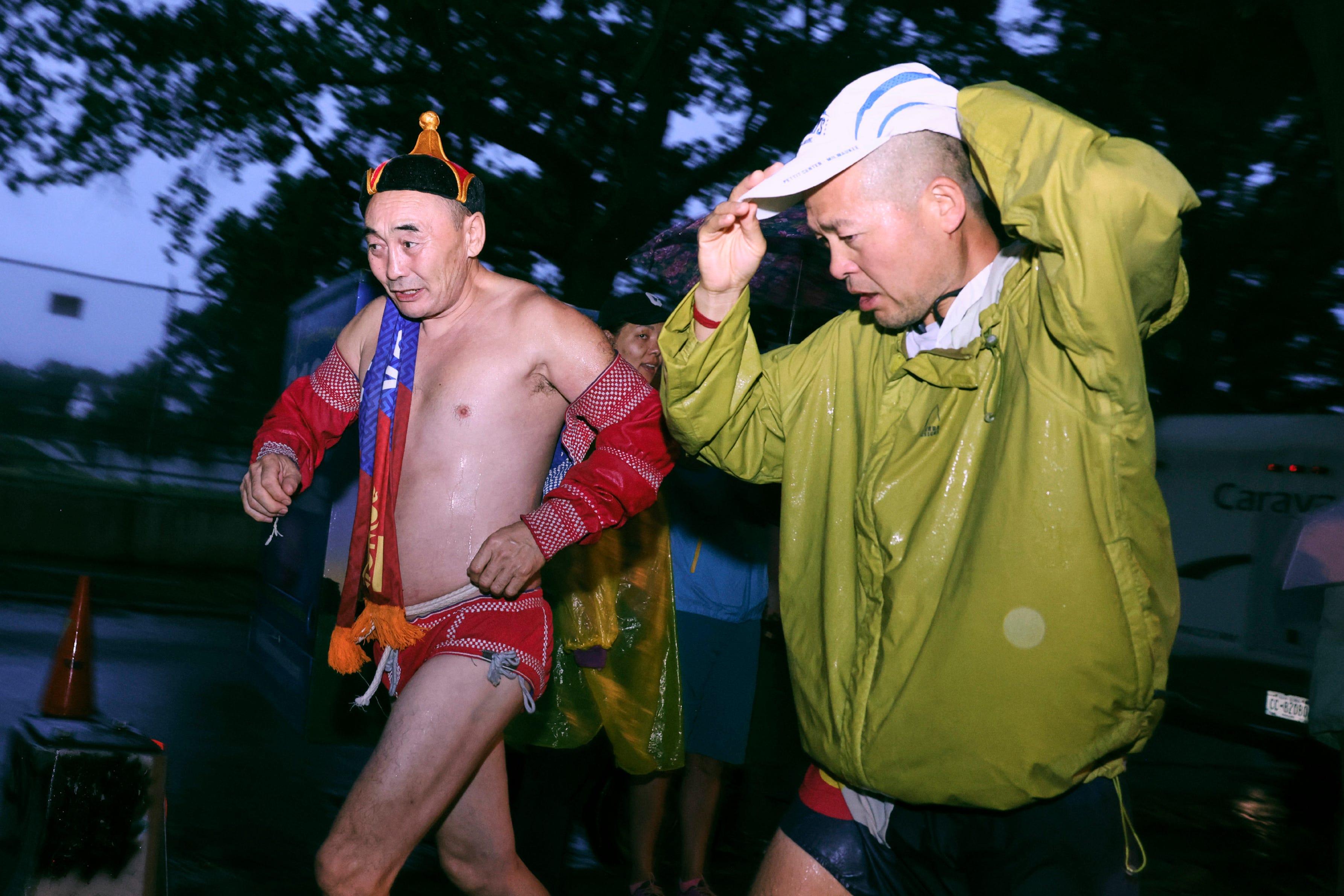
As a spectator, the runners might nod at you. Some will smile at you. Other times, it’s as if everyone on the course or the sideline is invisible to them. The runners enter a state of focus through their spiritual connectedness that seems like a necessity for such a repetitive act. I wanted to learn more about them as individuals but felt that I’d be interrupting something that I didn’t quite understand. Eventually I did ask one of the disciples what compelled them to keep coming back to attempt such a difficult and occasionally absurd task: “As you will have noticed, many runners choose to return to the 3100 mile race, even having already achieved the distance. That’s perhaps the most baffling thing to a non-multiday runners,” he said. “But most multiday runners will attest that there’s a point in a race where the runner’s body and mind enter the flow state. And often, once in that state, they remain there until the race is done. Of course, there are momentary bouts of fatigue, pain and discomfort. The opportunity to spend days, or in the case of the 3100, weeks in that flow state keeps runners coming back."
There are two restaurants in Queens that Sri Chinmoy disciples operate -“Panorama of my Silence Heart” and “Smile of the Beyond.” One is staffed entirely by women - the other by men. I had just spent the afternoon spectating, so I decided to ride my bike over to “Panorama”. It was a Thursday so DeAngelo recommended that I order the soup of the day - vegetable barley. I also ordered a drink called Instant Happiness; double shot, cream, vanilla and caramel - and drank it underneath a framed photo of Sri Chinmoy lifting 7,063.75 pounds with one arm.
Before I knew the Self-Transcendence race existed, I experienced the grueling 3,100 mile distance myself in 2017 when I crossed the country by bicycle. My friend and I rode from New York City to Portland, Oregon to witness the total solar eclipse that was happening on the West Coast. From start to finish, the ride, coincidentally, took us 52 days - the exact number that the runners are allotted to complete their own 3,100 mile journey. We weren’t racing, and our trip was fully self supported, unlike the runners of the Self-Transcendence, some of whom have small networks of financiers. We had to carry our own food and water, find places to sleep each night and navigate the network of highway shoulders, small town roads and bike paths in order to reach our destination. Mentally, I’m familiar with how it feels to cover that distance under my own power, and there were times where deep, meditative thought was an almost involuntary part of my experience. Riding my bike through the North Dakota Prairie felt particularly infinite. We had averaged 70+ miles a day for 26 days prior to reaching North Dakota. Once we arrived in the Peace Garden State, we quickly decided that we wanted to push ourselves to reach Montana as fast as we physically could. We found a rhythm and rode 151 miles through the plains on day 27. I remember my head spinning when we stopped to eat lunch. It was hot, and windy and every stretch of litter strewn highway looked the same. It felt like North Dakota would never end; but eventually it did. I think the runners experience a lot of day 27s. Days where they embrace monotony and the physical and emotional challenges all while telling themselves that they’ll feel better when they come out the other side. Thinking back to how difficult that ride was on a bicycle, I’d be hard pressed to convince myself to attempt the same distance on foot.
In 2015, Finnish ultra-distance runner and Chinmoy disciple Ashprihanal Aalto won the race and set the world record for the fastest time on the course. It took him 40 days, nine hours, six minutes, and 21 seconds, at an average of 76.75 miles per day. When he finished the race, he told the Sri Chinmoy Marathon Team in an interview, “This is a good place to make progress. Spiritual progress. When you run many races, this is, like, it, you know? After this race, the other races seem kind of short. So, it is like a great challenge. It’s good. It just goes on and on. Sometimes it seems like it’s never ending, so it’s great!”
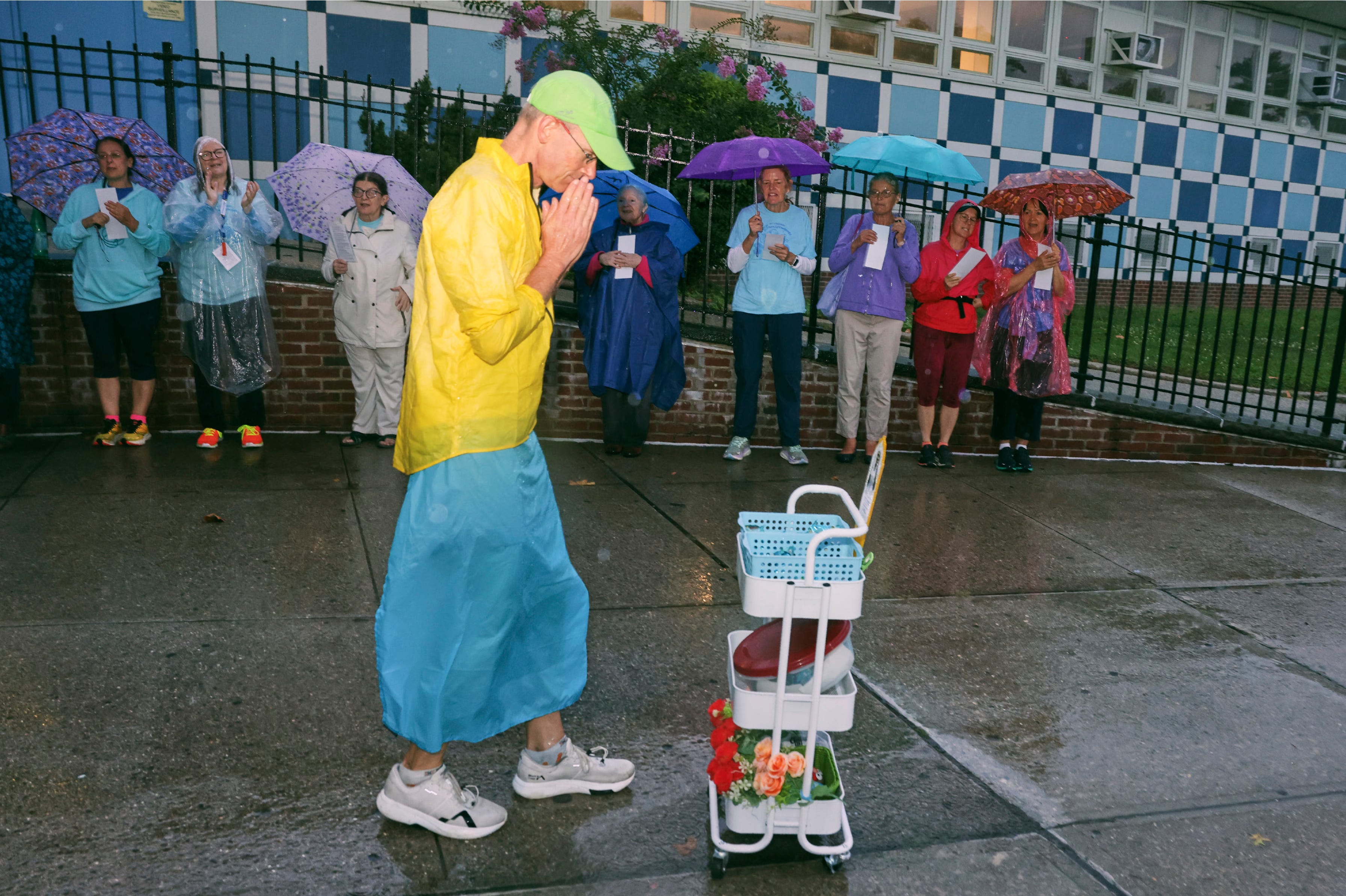
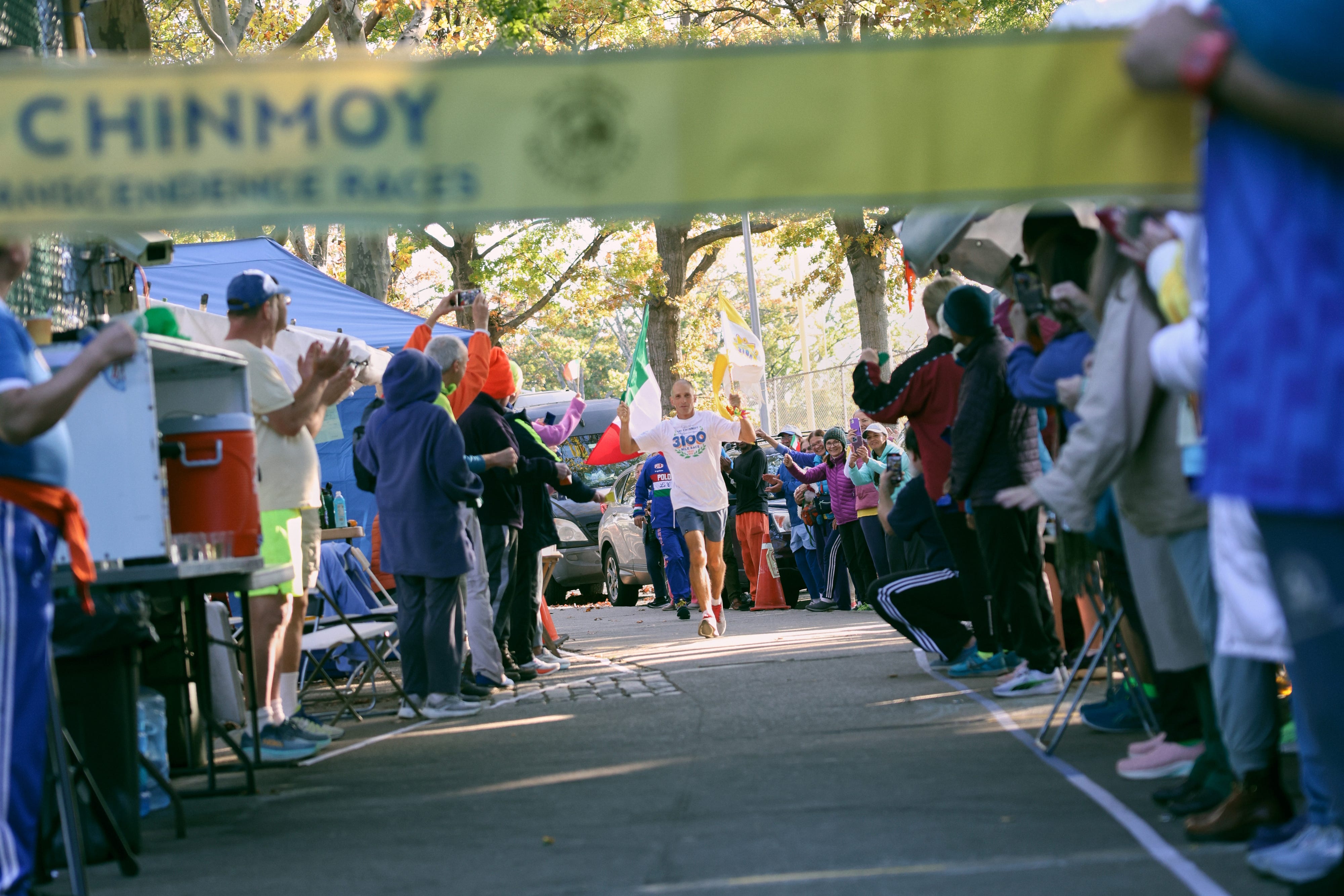
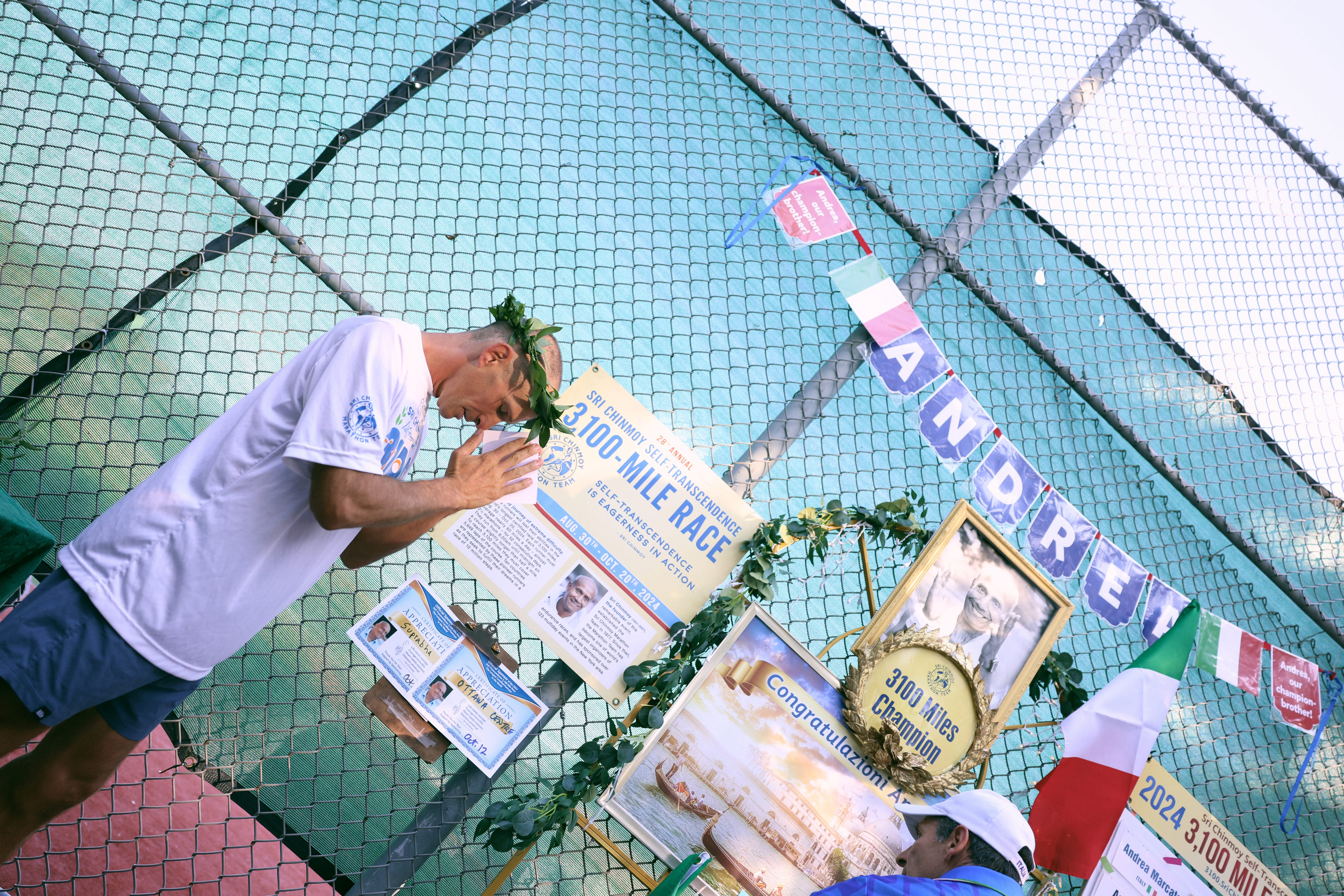
When I return on October 11th, the 44th day of the race, Andrea Mercato is only half a mile away from winning for the 5th time in a row. There’s balloons, a bouquet, a cake and a small, hard looking chair with a blanket over it just across the finish line. Roughly 100 people line the narrow sidewalk to get a glimpse of him breaking the tape. It’s the only day there’s been more than a handful of spectators on the course since it began a month and a half ago, in the pouring rain. Waving the Italian flag on his final lap, Mercato crosses the finish line at 9:05 AM, takes a bow and turns to a portrait of Sri Chinmoy that is fastened to the chain link fence with his hands folded in prayer position.
Once they complete the race, runners are given the option to run an additional seven miles so that their final distance reaches a round 5000 km. “3100 miles doesn’t equate to a nice number metrically”, Arpan told me. After a quick slice of cake, Andrea took off again. It took him an hour or so to cross the finish line for the second time.. All of the spectators had peeled off and only Mercato’s helper and I were there to witness the end. Mercato looked around at the empty area and said “That's it. I’m going to run one more.”
Subscribe now and receive a couple Victory stories a month, straight to your inbox. We’d love your paid subscription support if you’re able. It helps us keep doing what we’re doing. In the meantime, look out for great digital content, and we’ve still got copies of back issues, as well as subscriptions available. There’s never been a better time to enter into the world of Victory Journal. There’s a lot to discover.

Incredible article. I loved it.